Showing posts with label envelopes. Show all posts

Saturday, May 26

Opinions as Strong as Glue Stick

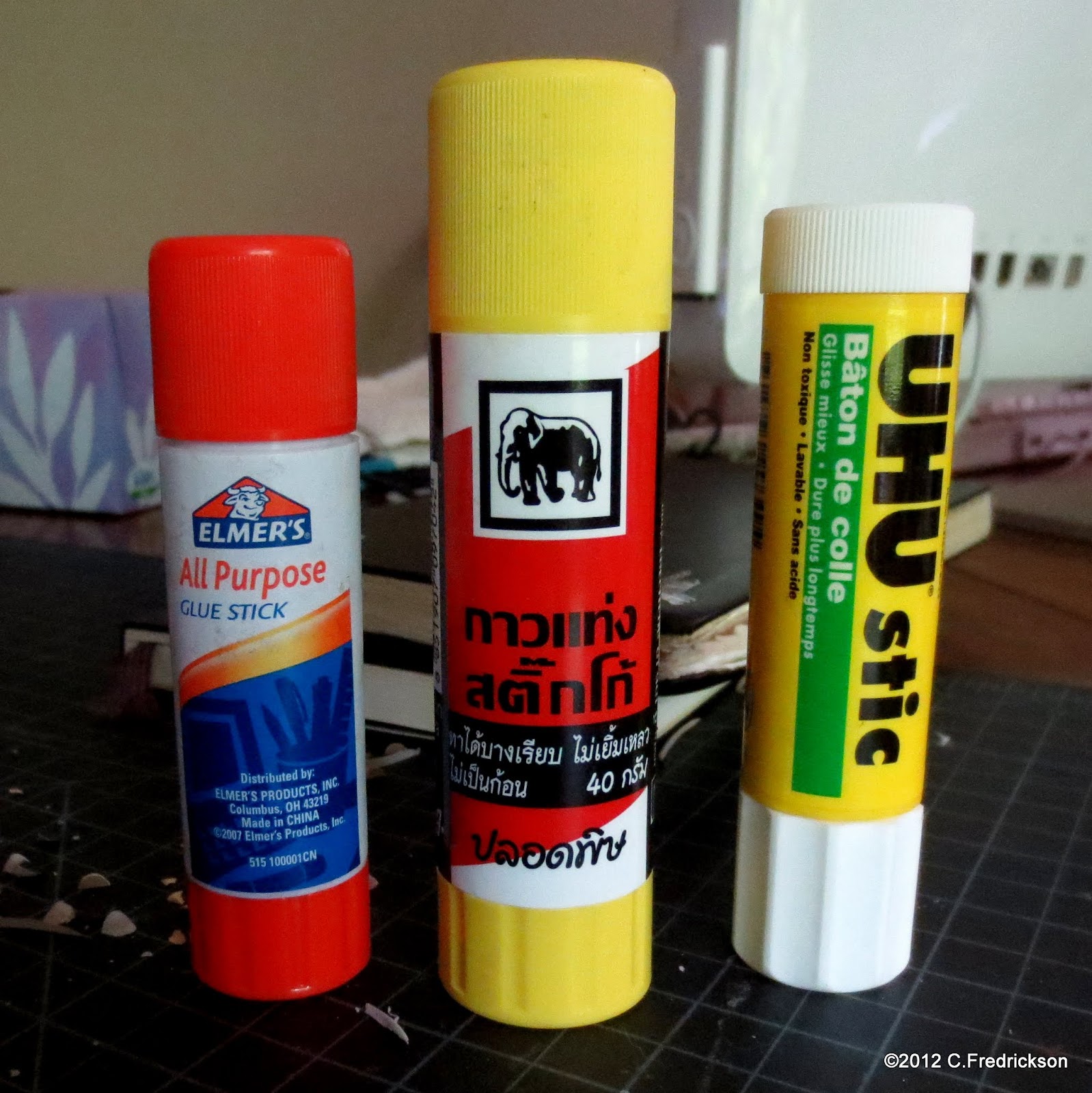
I'm sure everyone's been paying attention, but I feel like I need to be clear about my preferences in glue stick.

Is it urgent? No. I just like to boost for good products and warn against poor ones.

Is that geeky? Likely, but life's too short to want to be like other people, to live others' lives in replacement of one's own. And life's too short to be embarrassed—for very long—about flying one's freak flag.

I use a lot of glue stick (a lot) so I have some opinions about it. I've used it to craft and seal envelopes, to cover Moleskine notebooks, to wrap presents, repair library books, flyer around town, &c. In the course of using a lot of glue stick, one may develop a curiosity about alternative brands and, consequently, to notice trends and tendencies of one product against another. This is fine and natural, and I believe it's important to share one's impressions with others.

I'm sure I've used other, generic glue sticks before, and if I were very diligent I would run out and pick some up. I know Office Depot has a house brand, and Target probably carries alternate brands. I'm only reviewing what I happen to have on hand.

Sunday, February 19

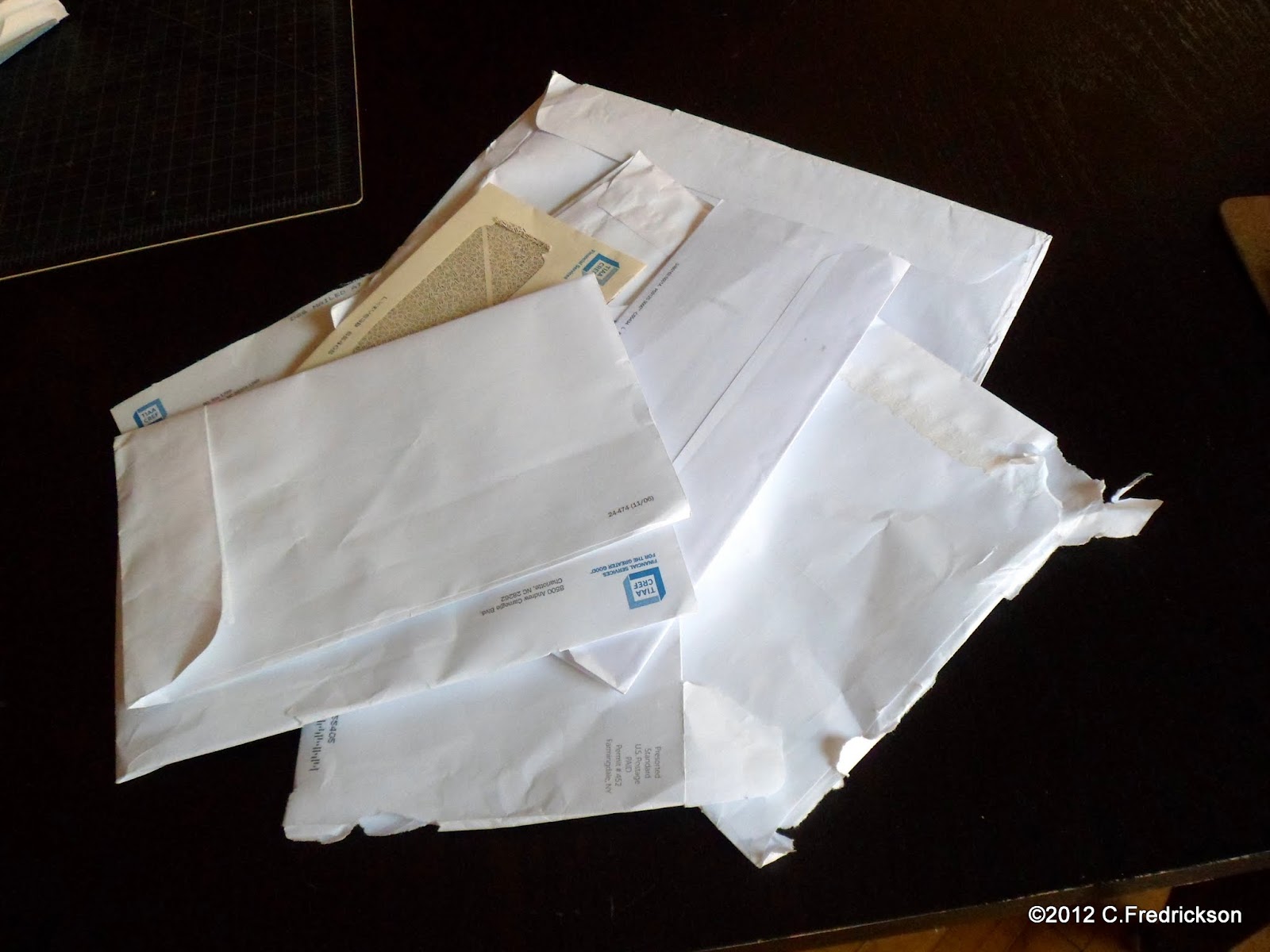
DIY: Notebook Made of Junk Mail

Hmm, here's a ridiculous little project for when you've got too much time on your hands. Maybe you had a really strong coffee and—like me—maybe you recently came into possession of a large quantity of chocolate chip cookie dough, and you make yourself piles of cookies with wanton abandon. That's where your energy comes from.

Look at this: investment companies, radio stations, and
grocery stores are just throwing resources at you.
And let's also say that—like me—you have an endless and unstoppable stream of junk mail flowing into your living space. Further, let's suppose that—like me—you don't have any paper product recycling infrastructure in your neighborhood. Glass and aluminum, sure, but not paper. Weird, right?

(Also, we seem to have a lot in common. Maybe we should hang out?)

Tuesday, February 7

The Quick-and-Dirty Short Fiction

I have a humble formula for generating short stories. It's a little simplistic, but when I'm absolutely scraping for ideas, a big, elaborate convolution of high concepts won't help me. I just need a quick-and-dirty checklist for a basic short story, just to get something written. Later, when I'm convinced of its brilliance, then I can worry about the complicated matters.

First, pick a conflict: Man vs. Man, Man vs. Circumstance, or Man vs. Self. I know there are over thirty tropes, but these three will suffice. Next, I write a little column of three abbreviations...

Friday, June 17

The Ecologically Minded Correspondent

Okay, so I'm poking around on Postcrossing (the postcard exchange program I cannot stop talking about) (partially because getting anyone else to take 20 minutes out to write me a note is like pulling teeth out of Congress), and I notice a little sidebar. Someone has assembled a small list of Things You Can Do To Make Your Postal Experience Greener!

I'm very eco and green, and I'm very against greenwashing. Traveling around southeast Asia was really hard for me and my wife, in an ecological sense, both because of our awareness of how un-green it is to travel at all, and because we were routinely confronted with the repercussions of climate change our own nation had initiated but for which these developing nations had to suffer. Imagine you're a Lao farmer, you grow your own food, you walk or bike everywhere you need to go, you reuse materials in ingenious ways to suit your needs, and then your lake dries up and your livestock die because Americans need more oil than anyone else, and more every year, and they don't believe in recycling. So the carbon they eject warms up the atmosphere, which traps more moisture, which traps more heat, and all your sources of water dry up. And you can't appeal to your government for relief because it's resolutely corrupt all the way through.

Welcome to scenic Phonsavanh, Laos! Please don't step
off the marked trails as there are still unexploded bombs.
It's heartbreaking to listen to their stories, their confusion at having lived sustainably for several generations, only this year it doesn't work because of what the rest of the world is doing, so they're going to starve to death unless one of their children can learn English and sell enough tours (of their barren, desolate wasteland) to drunken Australians or British lads to bring rice to the table, after repaying their bank loan for a dozen thousand dollars to finance their tuk-tuk, the first of many petrol-guzzling vehicles necessary for these tours. ...But I digress.

So writing letters isn't a very green practice. It involves printing paper with ink, hauling loads of postal cargo across continents and oceans by horrifically fuel-burning vehicles, and all the oil that runs the processing machinery and gets it all sorted. This list of ecologically responsible practices seems... a little pathetic in the face of what the planet is confronting. Very too-little-too-late. I was hoping for some brilliant innovation that I could implement to feel like I was really paying some penance for a lifetime of thoughtfulness. None of that was to be found here, however.


  1. Choose recycled postcards or postcards made with fibre that comes from sustainable forests. For instance, FSC certified postcards.
  2. Reuse/Recycle envelopes (it can be fun!)
  3. Use envelopes/writing pads made of 100% unbleached recycled paper.
  4. Walk, or ride your bike to take your mail to the Post Office.
  5. Write your postcards during daylight, or outside in the fresh air, and save on energy.
  6. When soaking off your stamps do them all at the same time and reuse the water as much as possible.
  7. Use refillable pens/highlighters etc.
  8. Print on both sides of the paper or reuse old study courses etc. to print things for personal use.
  9. When wrapping things, reuse gift paper. Be creative! You can use old maps, newspapers, pages from magazines etc.
  10. Get your electricity from a company that provides it from sustainable energy sources such as wind farms, solar energy, hydro energy, etc.
  11. Support an environmental organisation such as Climate care, WWF, Greenpeace etc.
Here's my categorical response to each item in this list.
  1. I don't know where to get recycled postcards. I haven't seen any that market themselves as such. I've tried making my own postcards, but many users specifically request not to receive these things.
  2. (See #1) I have made my own envelopes out of whimsical materials, and it can be fun, but it is still 1/16th of a drop in the bucket.
  3. This is a postcard group, and they're offering advice on pads of paper. I don't use pads of paper when writing postcards. The only pads of paper I use, I use as mousepads so I can quickly write notes while I'm surfing online, and those pads were salvaged from a dumpster, were purchased four decades ago, which is pretty good for reusing materials instead of buying new ones.
  4. Absolutely, I walk or ride my bike everywhere, or use my city's wonderful mass transit services (bus and LRT).
  5. The fact that I write my postcards during the daytime in no way mitigates how much light I use at night.
  6. I don't soak off my stamps. If I wish to save them, I scan them in.
  7. Absolutely, I prefer fountain pens that require refilling.
  8. When I write letters, I always write on both sides, but again, this is a postcard club.
  9. My sister and I wrap our presents in the same sheet of cloth we've reused for years. There's a wonderful website put out by the Japanese government, providing citizens with ingenious wrapping methods (furoshiki) for variously sized and proportioned gifts, to promote the reuse of cloth wrappers rather than paper.
  10. I have no idea how our electric company gets its power. There is no competition for it, however.
  11. Support those groups, but research them first. There are far too many groups doing the same work but diffusing donor funds too thinly to be very effective. There are also corrupt or at least wasteful, inefficient non-profits who don't know how to bring their administrative costs down. Maybe you want to support a powerhouse like Greenpeace, but maybe you don't want to support domestic terrorists like Greenpeace.

Thursday, June 17

Making a Fold-and-Mail Letter

I'm still working on this, a project in progress. I know there's a simple and obvious way to make a good fold-and-mail letter, but I haven't quite put it into practice yet.

Observe my crude pattern on the left. Ideally, the bottom half of it should fold up into the top half, and the flaps should not only enclose it securely but the corners should run flush against each other as well.

Can't say that happened exactly, though it was close. I'm making these as part of an interactive project from Facebook--actually, I probably mentioned it back in April. Too lazy to check right now. The gist was this: I posted a meme that solicited five people to sign up (who would also repost the meme). For each of these five people I had to create and send some kind of creative project, and since all I know is stationery, I thought I'd make some postcards and a fold-and-mail letter for them.

It's just that I didn't think this thing through. Each fold-and-mail item is one exterior and two sheets of paper, each sheet being half of one regular piece of paper. I glued in the sheets at the top, just below the large upper flap, so you could fold the exterior and the sheet-halves in their middle, then seal it down with the three flaps.

I think, to really help the folding and the edges meeting up nicely, one might trip about 1/8" off two perpendicular sides of the sheets of paper, but not the exterior. This should give the paper enough room to bulk up with the fold and not create extra space before the flaps can fold in.

But here's my pattern, if anyone else thinks they can use it. This isn't the cardstock envelope I promised back in December. I'm sorry about procrastinating on that thing, but I haven't forgotten about it, and maybe crafting and scanning my design for this project will motivate me to perfect and upload the envelope pattern.

Anyway, the flaps seal with double-sided window insulation tape. I trimmed it in half lengthwise to be narrow enough for the side flaps--otherwise, you can't beat it for adhesion. Leave the backing on for the letter-sender to peel off just prior to mailing. Better solution than sending everyone a glue-stick they'll use once and lose. And the address labels are my own design: I carved out the border in linoleum, stamped it onto parchment, then cut it out closely and glued it to the front of each exterior.

Wednesday, May 19

Illustrating the Distances

This was a great idea that never got off the ground: Google Map Envelopes.

Ideally, what you would do is write out an e-mail to a friend, then click the Google Envelopes button at the bottom of your text window. It would serve as an extension to your Gmail account (and it assumes you have entered your friend's mailing address).

"For a small fee" the program would print out your e-mail, fold it up, and insert it into an envelope that had been printed with a map of the distance between the sender and the recipient. Obviously, it would have to turn the map around most of the time, in order to make the sender's location always appear in the upper left.

Don't read the comments of the article in the link I provided, though. "Don't read the comments" is generally good advice wherever you read news on the Net, but it merits being mentioned in particular. I'll sum up: a bunch of people are very upset about the amount of paper that would be "wasted" on this project. Yet I doubt every single one of them is dedicated to recycling and mass transit, or even growing their own garden and storing solar/wind energy. They're just very judgmental of other people.

Personally, I thought this would have been a cute, fun idea to encourage people to send actual letters to each other. Yes, I hold the postal system to be particularly darling and I vaunt a little letter-writing above complete and total reliance upon online communication. And it's no secret I'm enamored of Google products, so I'm disappointed on a number of levels that this service never manifested.

P.S. Sorry for the lack of entries. Both my tower computer and my laptop crashed last week and I've been getting them examined. The tower is back home and running swell, but the laptop issued smoke out its rear ports and is pretty much cashed.

Saturday, April 3

Int'l Girl Aerogrammes

Just added a new link: International Girl aerogrammes. Check 'em out!

These are the fold-and-seal letters of which I'm so enamored. I've seen them in various styles and alternate themes, like the very fun Mr. Lunch series as well as Gumby & Friends, and then there was a crappy set that featured a talented French photographer, but when you folded them they never came out even and overlapped their edges or folds.

These look fantastic, and they come in various international themes, such as Chinese deco, Japanese kanji, Arabic birds, &c. You order them in packs of ten, which includes five motifs and two of each motif, and it comes down to US$16 (incl. shipping & handling). These look so interesting and exciting, I anticipate picking some up very soon.

I heard about these through the Postcrossing Web site: they've recently hit 4,000,000 postcards exchanged. I went back through their blog and discovered that Int'l Girl aerogrammes were the prize for the 3,000,000 postcard contest--users had to guess which countries would be the sending and receiving nations. Layers upon layers of fascinating information, for me.

Sunday, February 21

Letter Writers Alliance

Here's something I'm very excited about: dusting off my Cross and Retro 51 pens, filling them up with Noodler's and Mont Blanc, and sitting down to write on this lovely stationery from Letter Writers Alliance.

Last weekend I went to visit my favorite stationery store, Lunalux, because my friend and its manager, Jenni, was producing customized stationery to promote her new Stationery Saturdays event. For $29 I got six pocket notebooks with my wife's name printed on them (I kept one for myself but gifted her with the rest), having selected the cover and the paper within. Very nice stuff, and then I hung around for conversation.

Jenni asked me if I'd heard about the Letter Writers Alliance and I had not. I had just finished telling her about my standby, Postcrossing, and that's why she mentioned this group. Part DIY store, part pen pal group, and more than those, LWA is a branch of 16 Sparrows which has a broad range of interests in crafting, retro aesthetic, photography, just a lot of very creative stuff. Not the highest, cutting-edge creativity because that's too inaccessible: this place is a study of how people can bring creativity into their own lives, how they can compel it out of themselves. That's what makes it dear and sweet: it encourages everyone to do their best and assures them that it will be great.

But the LWA! I'm excited about this. I got my brown-paper-and-string package in the mail, broke into it to check out my stationery, immediately put my LWA pin on my label, filled out my membership card, logged onto the members-only area of their Web site, and dwelt in a geeked-out haze for a while. I'm trying to think of any other discrete event in recent past that has made my writing-hand itch so badly to begin reaching out to my friends. This afternoon I've written two notes on this paper and will write more. I'm going to write to the people who have been most important in supporting my need and custom for correspondence (e-mail inclusive), so I had to get a photo of this paper before I sent it all out.

Now I want to do more with Postalatry, dress this place up and try to appear a little more relevant just in case anyone from LWA happens to swing their eyes my way. I'm just thrilled to be part of this very nice-looking creative group, excited to be writing letters again (I never stopped writing postcards, but it's easier to do that when you do not expect anyone to write back, as per Postcrossing), and feeling more than a little validated in my interests. Some of my friends like to poke fun at the antiquity of some of my pastimes, the... I lost the word, I had a great word that specifically centered around the interest in things that are old, specifically for its oldness. And that's not me, but it's useful when representing the crap I take from people whose values lie with the latest technological breaking news.

So I'm glad to be part of the Letter Writers Alliance.

Sunday, February 14

Mystery (Partially) Solved

The astute reader may recall how proud I was of constructing these accordion-sided envelopes for distribution, how I'd labeled them with these address labels from Red Horseshoe, and how one fell off of the envelope in the mail, so the letter was lost but the post office delivered the address label (bereft of envelope and missive) to the intended destination.

Sounds silly, doesn't it? The post office's behavior? "Sorry about your letter, it's gone and trashed, but we thought you would value this address label."

But how does an address label fall off of an envelope? The paper of the envelope I chose is stout and porous, any adhesive should hold to it. Except the Red Horseshoe adhesive does not: with a liberal soaking, it can't get up enough gumminess to adhere to anything, though a sticky paste is formed so it's clear that this is the intent. I finally did get the label to hold to the envelope by gluing it down with glue stick, and when the label fell off I was afraid the cheap-ass glue stick had failed. The astute reader will recall my rejoicing at having found an "extra strength" glue stick.

It wasn't the glue stick at all. It was the address label.

I dug out the other envelopes I made and tried to pry off the address label, expecting to find a dry, crusty bed of failed glue stick. Instead, the paper address label lifted clean away to reveal a plastic backing, as though the address label were a sticker to be peeled off of its backing and affixed to an envelope! There were no instructions with this book of address labels (they're bound together on one side and you tear them off as you use them), and the process seemed fairly intuitive. I mean, the apparent back did have an adhesive on it that responded to moisture. But I was entirely unaware of this plastic backing to the label until ten minutes ago!

The back of the address label is slightly sticky, so it sticks slightly to the plastic backing but not to the paper of the envelope. Even if it was intended that you peel off the backing and apply it to the envelope, it would just fall off anyway! Does it need to be further moistened and adhered to the envelope, or do you peel it away from the plastic backing in order to have a clean surface for yet more glue sticking? I'm trying to find the pad of Red Horseshoe address labels so I can determine whether they are supposed to be stickers you peel off and use, but I can't find the pad anywhere so I may have thrown it away in a huff.

Oh, and mind: the plastic backing also flakes uselessly away from the front of the envelope. There is no part of this address label that is prepared to stick to the envelope, in summary. I love the retro restorative look to Red Horseshoe's products, but I'd much rather they work properly. (Note: I can't find these address labels anywhere on their Web site. I'm guessing they called it a wash.)

Monday, January 18

Making Your Own Cardstock Envelopes

Okay, here's a little something: when sending the holiday cards, we ran out of envelopes. I had to make my own, a process to which I am no stranger, but the cards themselves were almost square. When compensating for a little room beyond the card's edges, the envelopes were almost completely square. The bad thing about that is, square envelopes and postcards incur a 13-cent penalty. Granted, thirteen cents isn't going to bust the bank, and room for stamps isn't an issue since you can put stamps anywhere you like on the face of the envelope (they told me so at the post office), but... call me a traditionalist and a stingy bastard: I didn't want to spring for the extra postage.

So I designed an envelope. I'll update this post with a nicer PDF copy of it, that will be my gift to you, my four readers, but here are the photos of the process.


Okay, in the first picture, what are we looking at? The envelope itself is two separate pieces of paper: the front is a nice decorative piece of cardstock, and the back is a very simple, very plain monochromatic piece. The top line drawing is the back and the bottom cutout will be the template for the front piece. I chose those angles for the tables completely arbitrarily: I'm guessing it's about 30º. You could use a 45º angle or whatever you like, actually. The important thing to understand is that the front piece has two side tabs that will be pasted on the inside of the body of the envelope and one large tab on top that will be folded down on the outside of the back. The back piece only has one bottom tab that will be folded up into the inside. I think you can see where I'm going with this.

The second picture represents each piece cut out in the desired materials. My wife found an excellent book of patterned cardstock, available at any scrapbook place for certain. Should be available in any craft store or some stationery outlets, perhaps.

The third picture is how you will lie the bottom tab of the back piece onto the low edge of the front piece. I made that flap extra big on purpose because I'm using that double-sided window insulator tape. Actually, I should've made all the flaps that big. No reason to give myself less surface area to work with, when using that double-sided tape, which I actually had to slice in half lengthwise for this project! That's ludicrous, no one should have to go through that.

But yeah, you tape (or glue, if you have an excellent glue you're comfortable with; I do not recommend glue stick unless you're very confident of its affixing properties) the large tab from the bottom of the envelope back to inside the bottom of the envelope front.

Now, the left picture shows the beauty of double-sided window insulator tape: you just leave that waxed strip on there until the last second. Were it not for that, you'd be stuck eyeballing how the two pieces will line up before you slap them together and clamp them down, praying to your deity of choice that you didn't miscalculate anything in this imperfect analog world. This way, you can line, align, and realign to your heart's content. When everything's perfect, just lift one corner of that waxed paper backing and whip it away. I think it's fantastic.

I'm not sure what the second picture represents. I took it about a month ago and its meaning is lost on me. I think I was just trying to represent how you shouldn't be afraid to shave off an edge if your measurements are slightly off. I'm definitely glad I invested in a self-healing cutting mat and a metal ruler (though sometimes that Xacto knife actually shaves slivers off the metal ruler, no joke).

With the large tab on the bottom of the envl. back affixed in place, it's nothing to tape/glue the side tabs of the front piece into place. Really, all the work of lining up the two pieces lies in that bottom tab. This is when it's invaluable to use that double-sided tape: line up the two pieces, pinch the right end of the tab, start peeling from the left, compress it there and peel the rest of the way. Simplicity itself.

All you need to assemble are the three sides of the envelope, and leave that fourth tab alone until you fill the envelope. Or, if you're giving a pack of these envelopes to a friend, leave that waxed paper strip on the fourth flap for a handy touch. Like I said, I'll draw up a PDF of the proper measurements. The two most important things are:
  1. Find a strong cardstock that won't crumple in processing, and
  2. Make tabs large enough to accept a strip of double-sided tape, and then some.

Thursday, December 31

Overtly Complete

Further proof that everything you can think of is already old news on the Internet: the Postage Stamp Calculator.

I'm in a postcard exchange network, Postcrossing, and so I'm sending postcards out to all nations of the world. Currently my sending limit is up to nine cards out there at once--everyone starts with a limit of five cards and you prove your devotion over time. Sometimes I have the appropriate postage and sometimes I've got a random assortment of stamps.

And sometimes I want to send a nice postcard that happens to be square. Square letters and postcards incur an additional 13¢ because they have to be hand-cancelled. Postal processing machines can't right the card/envelope into an appropriate position if it's not rectangular, so the post office has to tack on a little fee for the manual processing, yet the post office does not sell 13¢ stamps.

Enter the postage calculator. Type in all the denominations of postage stamps you have, type in your required postage, and it easily figures out how many of which stamps you need to meet the postage requirements. Sometimes you'll go over the amount, sure, but it's usually by only a few cents and it's still easier than driving to the nearest post office and buying the exact amount of stamps.

Or maybe it's not. If it's not, you should definitely patronize your local post office. If it's an inconvenience (like for me, between the holiday crowds and all the streets being coated in glare ice), go ahead and use up some of the extra stamps you have lying around.
Q: Is it easier to type in all the denominations of postage you have or to do the simple math and figure it out for yourself?

A: Go away.

Friday, December 18

Crafty Advice

I'm still working on the holiday cards but they're not done yet, so I still can't publish the photo-documentation of making these things. Because there's so many of them, it's a lot of work to execute each stage. My wife and I alternate shifts of motivation: sometimes she's all, "We've got to get these out the door this weekend," and I'm stuck playing free MMOs for my other blog. Alternately, I'm all, "Please do your part of the writing on the backs of the cards," because the handwriting would turn out all uneven once the interior mechanism is in place, and she's fixated on World 6 of Super Mario Bros. Wii.

But we are getting it all done, slowly done. I'm also learning a lot throughout the process. A few days ago I was talking with her about what it is I really, really need in terms of stationery. I saw this intriguing Japanese postcard kit--it uses shaped foam brushes instead of hair-tipped brushes--and realized that I already own the most important elements of that kit. It wasn't worth $24 for materials that could be gotten cheaply as individual parts. So I decided what I really needed was stronger cardstock, since I tried using the post office's pre-stamped postcards for a watercolor project and they warped all to hell. I was frankly surprised they reached their destination.

Harder cardstock is easily had, but does that solve all my problems? I can print my own stationery, I can cut out my own envelopes... ah, there we go! I need to create a more attractive laser printing system for address labels! Because I can find some appealing but very busy design on paper, carve it into an envelope, and there's no way I could use any kind of writing implement to scribe an address any person or machine could read (though I wonder if there is a reactive ink that a postal scanner could read better than the naked eye can? And if it's invisible, my gosh, wouldn't that be cool!).

Eventually I realized the problem isn't in the labels, it's in the adhesive. Remember how that one address label fell off of the envelope I sent to a new pen pal? And I've had other envelopes fall apart because the glue stick I used to seal them was grossly inadequate. And now I'm at a point in the holiday card assembly where I need to fold the cards in half and seal them in such a way the internal mechanism can move freely. I would've tried glue stick but actually used it all up on the internal mechanism (sorry to be so cryptic, you'll see what I mean soon) and had to fall back on this cheap Elmer's transparent glue gel, which is entirely unsuitable for this task. This morning I found that much of my binding had come unbound, and with a distinct lump in the center of each card, it's impossible to place a weight upon the card and ensure an even press all over its topography. The solution to that might be a small sandbag or even a bag of sugar/flour, in terms of household items, but I'm not going to fill 50 freakin' sandbags and spread them all over cards on the floor just to get a secure seal!

And then it hit me: I lost my job last Tuesday and, with my new-found free time, kept myself busy by sealing up the windows with sheets of plastic. Annual Minnesotan tradition for anyone who likes to keep warm. It took me way too long to realize that the double-sided Scotch window insulation tape is the perfect item for my stationery jobs!

I bought a spool of so-called double-sided tape before and it was crap. The adhesive itself peeled away from the plastic strip that was supposed to be coated on both sides. It was also unwieldy to use, tended to get tangled and folded, and brought much more frustration than convenience to my project. But this simple roll of Scotch window insulator tape peels off easily, pastes down neatly, trims handily, and whipping off its paper backing is simplicity itself. And that seal will hold! This is excellent tape, and I think I'm going to stop by the local hardware store and stock up on a couple rolls for personal use. Why didn't this occur to me before?

UPDATE: I got the cards finished and am hand-writing address labels to get them sent out tomorrow! I can start releasing my tedious photo-documentary!

Wednesday, November 25

Lost in the Mail

Bad news: one of my letters was lost in the mail. This is always discouraging when it happens, and it's one of the inherent risks of postal service.

I was using some address labels from Red Horseshoe, and they're very attractive but not entirely practical. They place the return address directly atop the destination address, and my concern was that an automated scanner might interpret the whole thing as one big address. When my recipient e-mailed me to ask whether I'd written her, I knew something was wrong because anything I send from the Central Loop Station usually shows up within 48 hours, in the contiguous U.S.

Sure enough, she e-mailed again to inform me that only the address label made it to her, accompanied by a boilerplate apology from her local post office. I knew the adhesive that came with these Red Horseshoe address labels was weak and ineffectual in all cases, so I attempted to bolster it with glue stick, which is usually pretty secure. But perhaps the paper I used was too smooth or not porous enough to give the glue some hold, and the label still flaked off the homemade envelope.

While e-mail has none of the romance or hands-on appeal of penning a letter and handcrafting an envelope for it to ride in, it is still exponentially more reliable than postal mail. And I'm not advocating a switch from postal mail, no, for I've had many successes and relatively few failures using this system. (The failures have been pretty dramatic, however.) It's just that I'm not a gambling man, and sending something via postal service is always a gamble, no matter how good the odds, and sometimes I lose.

Thursday, October 15

Envelope Assembly

I've had reason, recently, to get back into making envelopes. I'm quite pleased to do so: I have a number of pen pals--some of whom are feeling quite neglected lately and so I thought I'd produce something a little special to begin to make up for my inattention.

Several years ago I picked up a packet of envelope templates from a local store, Lunalux, who in turn informed me they were made by another local crafts-person. I won't expound upon the potential environmental benefit yielded by purchasing locally produced craft supplies, but I was pleased to be part of an insular crafts-sphere, of sorts. The envelopes I made from these templates were so admired by one of my pen pals, a DJ in Madison, that she requested a kit of her own, which request I fulfilled.

The templates come in many sizes for different functions. Many are suitable for posting in the mail and may handily travel around the world, depending on the quality of paper you use. Others are a little more intricate or awkwardly sized for postal mail and would better accompany a gift or else might be handed off in person. I prefer those envelopes which lend themselves to being mailed, and I'm careful to outfit them for optimal postal travel: stout paper, all flaps and corners sealed flat, judicious application of stickers, &c.

These pictures are of my personal favorite template, a capacious accordion-sided envelope. I love it because it looks fairly elaborate, hearkens to the classic accordion folder, and permits quite a bit of storage. Also, as pictured, the broad front has enough room for these particular Red Horseshoe address labels as well as postage--not every envelope can say that, not until you start talking to large business envelopes. (Note: lovely though the labels are, their adhesive gum is weak and useless on its own; with the application of Elmer's glue stick, however, it becomes a sovereign bond.)

With this iteration, just as a little quelque chose, I tried out a manual airbrush/paint spatter, I guess you'd call it. It's a simple little device, basically a long, thin metal tube you dip into ink or thin paint/dye, then blow in the other end to spray it upon your paper/canvas/surface. I've never used it before but bought it several years ago with the desire to practice at it. Now I've finally used it and I'm not sure what caused the large globs of ink (I had the foresight to choose a grey ink rather than something darker and less forgiving), whether a finer spray might be achieved with a thicker--or thinner--liquid or whether I'm just doing it wrong, somehow.

So, there we are. I've made four of these bad boys: one will stay in Minneapolis, one will fly out to Turkey, and the other two? I'm not sure now what will happen to them, where they will end up.

Friday, September 25

Playing With Kozo

These envelopes were made with a super-handy envelope template I picked up at a local store. It's a kit with a selection of templates to make envelopes of various sizes and for various functions. My favorite was an accordion-sided envelope with a large back flap, best when made with stout parchment. I thought it was great simply for what it was, but it was especially handy when mailing an especially voluminous letter or a package of fun little extras.

The pictured envelopes are of the standard variety, but I'm coating them in a sheath of kozo paper. This is a Japanese paper made by laying out a large sheet of paper fibers in a room with a ceiling designed to leak profusely. The droplets create the pools and holes in the paper, which is allowed to dry with this random, natural formation.

Obviously it's terrible for making an envelope and worse for writing on, but it is a marvelous decorative feature. I dressed up these plain, lusterless envelopes with a judicious application of kozo and was quite happy with the results. The trick is in finding a way to glue the kozo to the envelope. My technique was to glue-stick the entire outside of the envelope and press the kozo flat. This was a poor idea because it left an envelope with dozens and dozens of sticky little holes all over its surface. A better solution might have been to use a spray adhesive on one side of the kozo.

Saturday, September 5

Giant Robot Postage in Space

This is pretty awesome: a complete sheet of GUNDAM stamps.

It doesn't matter who you are or what you're into. Maybe you like big giant robots in space, maybe you don't. Maybe you've heard of anime, maybe you haven't. Maybe you like Japan, maybe you don't. But you have to admit that a complete sheet of postage stamps featuring one of the most important anime titles to transform and define an entire genre is pretty awesome.

Do we agree? Can you give me that much?

Come on! Look at this! How important does an anime have to be to garner the office of postage stamps? That's significant! Yes, many other nations have plants and weeds and small animals on their stamps, but at least they're indigenous to their region. All you have to do is reframe your concept of "region" and you can move within any number of contexts! In the region of Japanese television, in the region of hand-drawn, career-seiyuu animation, in the region of epic storytelling, you have got to respect this. You have got to give GUNDAM its due.

If you can't, I will be forced to assume you are merely jealous.

Thursday, September 3

If I'm Permitted to Dream

Three years ago I visited an Independence Day celebration, "Fort Snelling, 1827." Fort Snelling is situated by the international airport in Bloomington, and each July they open the fort with recreationists and actors who enact various scenes, from mundane routines to special speeches and proclamations.

I believe this photo was taken in an officer's quarters, which is why it is so clean of straw and mud and uncluttered with bags and cases. It's a quiet room with a solid wooden desk, a comfortable wooden chair with padded leather, a solid brick floor set right into the ground (no echoing floorboards, no creaking, no carpet to fight), and a single inkwell waiting at one corner of the desktop. Missing would be a desk set, like a desk pad, paper holder, rack for quills, etc.

And me. I could write endlessly in this room. I would throw the windows open by day and write by candles or oil lamps by night. One wall would have a small and essential library: one shelf dedicated to copyediting, technique and usage; one for my most favorite novels and excellent examples of writing; one for my college textbooks on writing and craft, collections of The Paris Interviews and maybe a subscription to Granta or Utne Reader, just to keep abreast of different styles; one shelf would be a random assortment of books on loan, constantly updating, getting replaced. To the side would be my stationery chest, with a more serious collection of paper, inks, nibs, and accoutrement. Here I'd lock up anything that wasn't in use on my desk.

Against the other wall would be a dresser or armoire with as many clothes as I'd need for two weeks. With one collapsible cot and a sleeping bag, I should be quite comfortable in this room alone. And from this room I would reach the world--slowly, unreliably, but I would transmit and receive from this station.

And if I had the Internet... good night.

Friday, August 28

To Stick or Not to Stick?

I'm not one for cute little stickers, when it comes to crafting stationery. I don't feel it's enough, for a craft project coming out of me, to paste a couple stickers on a blank page and call it a day.

On the other hand, I have found some awfully cute stickers.

Pictured to the left is a selection of punk-themed stickers. These things are tiny, intricate, and in some cases fragile. The concept of Japan's impression of British punk (not the first time Japan has admired the traits of Great Britain) is irresistible to me. I love to think that it was some young Japanese artist's job to come up with an array of the accoutrements to punk music. Was she a fan of it already? Did the graphic design company actually hire some punky-looking Japanese kid off the street? Or was someone just tasked to sit in a room and study a bunch of old movies and music videos for reference?

Did that change his life? After the completion of this sticker sheet, did he abandon his proletarian values and take his burning message to the streets and stages of Tokyo, rebelling against the very establishment that created him?

Oh, one can only dream!

I also came into possession of a sheet of Doraemon stickers, very tiny, very cute. They featured him dressed in an insane variety of costumes and outfits, no repeats, dressed as anything from a samurai to a lobster. They were a nice accent on the corner of a page or envelope, just a subtle mark to catch the eye and cause to study, to wonder.

Tuesday, August 25

Wrapped in Culture

This will look odd, but it's better than me linking to a Word document for you to download.

What I did here was take a section of the ancient tale Beowulf, render it with a font (originally Calligrapher but, here, Calligula), fade it to a pale grey, and... I can only guess what this must've been for. Perhaps I canted it at an angle and carved envelope liner out of it--that certainly would have been a suitably creative project I'd've undertaken in my heyday. Unlikely that it would have formed the envelope itself, being that space is so limited in 8.5"x11" paper. If I could've brought this to wherever I was working at the time and printed it out at 11"x17", sure, then I could've done something. Third guess: maybe the background for address labels. Again, tilt them at an artistic angle, cut them up, and write something in bold black ink across the faded grey print.

The idea here was to impart the feeling of literary tradition, hearkening to a seminal piece of work, just as one would use photos of cemeteries to evoke somber feelings or a sense of horror. Lacking suitable materials, I have never been one to give up a project when I might craft the materials for myself. I think the only drawback to this particular project was that the laser printer ink tended to smear or blur in the process: I remember being dissatisfied with the result.

Oh well, caveat emptor.

Monday, August 24

Alternative Envelopes

In an effort to reduce the amount of physical clutter in our apartment, and consequently increase the amount of space, my wife and I undertook several projects from donation/regifting to savage, unconscienable trashing of our property. It was obviously more satisfying to pass something useful on to someone who would appreciate it, but when push came to shove we found ourselves not above hauling a bag of crap to the trash bin out back.

In the case of DVDs, what we did was this: we decided we didn't care about owning the case that it came in and invested in some nice DVD albums. We removed the jackets from the DVD cases, trimmed them down to a size where they would fit in the album with the DVD, and discard everything that remained. Now we have lovely albums grouped by genre and the compendiums look no different than any other large tome on our bookshelves.

In the case of the pictured, these were slipcovers that went outside the box or case in which the DVD rested: extra packaging! Normally evil, but in this case useful. I saved several of my favorite slipcovers and intend to convert them into envelopes for letters for friends. They're stored in my stationery cabinet until when cometh such day as I may use them.

Who will get them? Who deserves them? It is impossible to know for now.