Showing posts with label paper. Show all posts

Saturday, May 26

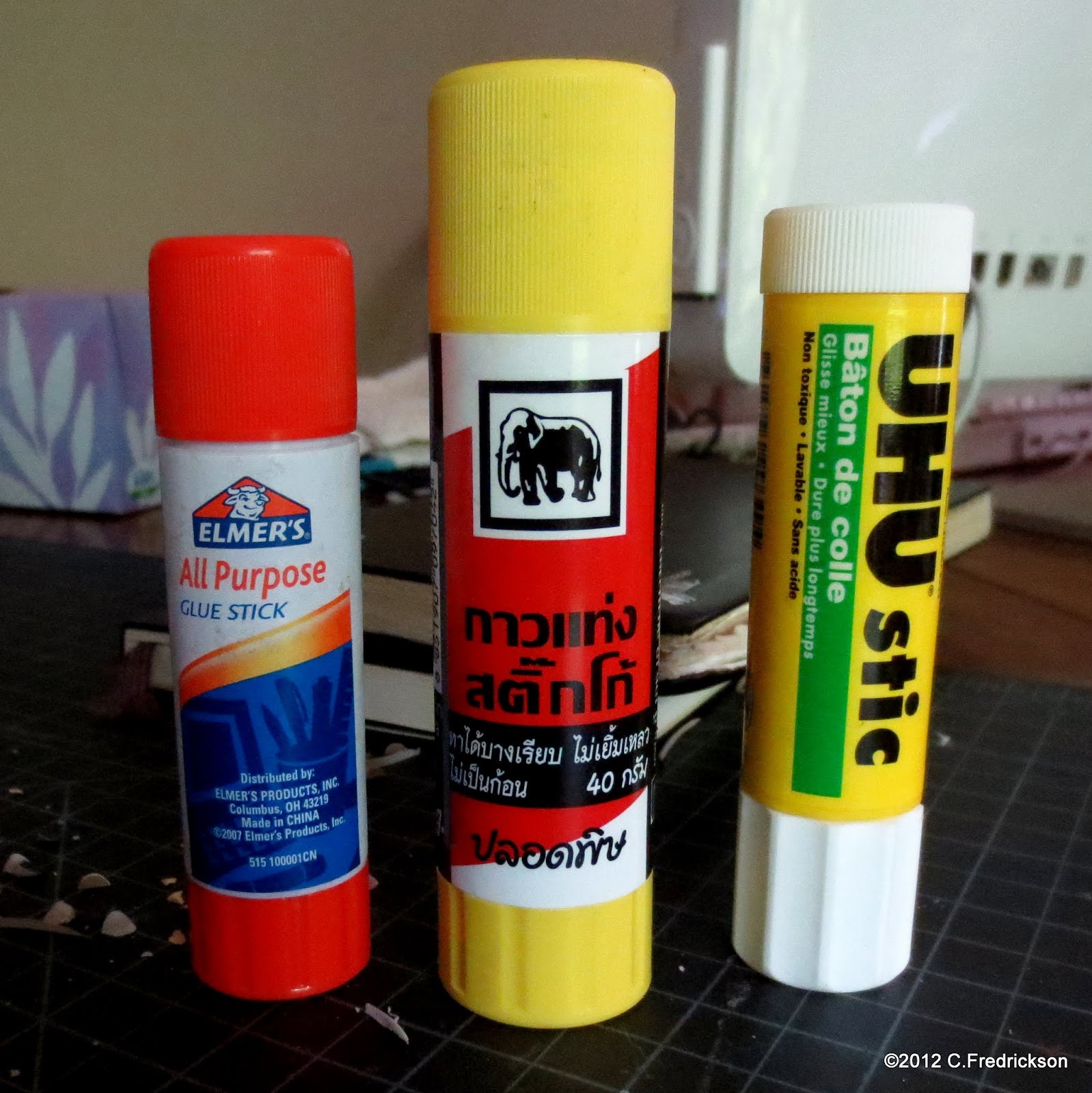
Opinions as Strong as Glue Stick

I'm sure everyone's been paying attention, but I feel like I need to be clear about my preferences in glue stick.

Is it urgent? No. I just like to boost for good products and warn against poor ones.

Is that geeky? Likely, but life's too short to want to be like other people, to live others' lives in replacement of one's own. And life's too short to be embarrassed—for very long—about flying one's freak flag.

I use a lot of glue stick (a lot) so I have some opinions about it. I've used it to craft and seal envelopes, to cover Moleskine notebooks, to wrap presents, repair library books, flyer around town, &c. In the course of using a lot of glue stick, one may develop a curiosity about alternative brands and, consequently, to notice trends and tendencies of one product against another. This is fine and natural, and I believe it's important to share one's impressions with others.

I'm sure I've used other, generic glue sticks before, and if I were very diligent I would run out and pick some up. I know Office Depot has a house brand, and Target probably carries alternate brands. I'm only reviewing what I happen to have on hand.

Saturday, April 28

DIY Deco: Moleskine Notebooks

Now, anyone who's read EVERYTHING I'VE EVER WRITTEN EVERYWHERE may have detected by this point that I'm favorably inclined toward Moleskine (MOLL-eh-SKEEN-eh: I correct myself whenever I say it). And I have found there are two Moleskine websites: Moleskine (Europe) and MoleskineUS. Why are there two? I dunno, maybe it's just easier to have a European headquarters that takes care of all nations outside of the U.S.

The Euro Moleskine site has what they call an Artists Marketplace: users are invited to buy Moleskine notebooks, decorate them inside and/or out, and sell them here to a global market. I decided to try my hand and take the plunge, but so far there have been no takers. None from other countries, anyway: my friend Kate met me and, over ice cream, perused my selection and decided which (of the three I'd produced) she wanted.

Let me tell you about these notebooks. I purchased the pack-o-three "large" unlined Moleskine Cahiers with kraft covers. Among my statio is a file of old maps, so the notebooks are covered in a 1965 National Geographic world map. Their covers feature the South Atlantic Ocean (pictured), the North American continent, and the Scandinavian nations and northern Europe.

Friday, June 17

The Ecologically Minded Correspondent

Okay, so I'm poking around on Postcrossing (the postcard exchange program I cannot stop talking about) (partially because getting anyone else to take 20 minutes out to write me a note is like pulling teeth out of Congress), and I notice a little sidebar. Someone has assembled a small list of Things You Can Do To Make Your Postal Experience Greener!

I'm very eco and green, and I'm very against greenwashing. Traveling around southeast Asia was really hard for me and my wife, in an ecological sense, both because of our awareness of how un-green it is to travel at all, and because we were routinely confronted with the repercussions of climate change our own nation had initiated but for which these developing nations had to suffer. Imagine you're a Lao farmer, you grow your own food, you walk or bike everywhere you need to go, you reuse materials in ingenious ways to suit your needs, and then your lake dries up and your livestock die because Americans need more oil than anyone else, and more every year, and they don't believe in recycling. So the carbon they eject warms up the atmosphere, which traps more moisture, which traps more heat, and all your sources of water dry up. And you can't appeal to your government for relief because it's resolutely corrupt all the way through.

Welcome to scenic Phonsavanh, Laos! Please don't step
off the marked trails as there are still unexploded bombs.
It's heartbreaking to listen to their stories, their confusion at having lived sustainably for several generations, only this year it doesn't work because of what the rest of the world is doing, so they're going to starve to death unless one of their children can learn English and sell enough tours (of their barren, desolate wasteland) to drunken Australians or British lads to bring rice to the table, after repaying their bank loan for a dozen thousand dollars to finance their tuk-tuk, the first of many petrol-guzzling vehicles necessary for these tours. ...But I digress.

So writing letters isn't a very green practice. It involves printing paper with ink, hauling loads of postal cargo across continents and oceans by horrifically fuel-burning vehicles, and all the oil that runs the processing machinery and gets it all sorted. This list of ecologically responsible practices seems... a little pathetic in the face of what the planet is confronting. Very too-little-too-late. I was hoping for some brilliant innovation that I could implement to feel like I was really paying some penance for a lifetime of thoughtfulness. None of that was to be found here, however.


  1. Choose recycled postcards or postcards made with fibre that comes from sustainable forests. For instance, FSC certified postcards.
  2. Reuse/Recycle envelopes (it can be fun!)
  3. Use envelopes/writing pads made of 100% unbleached recycled paper.
  4. Walk, or ride your bike to take your mail to the Post Office.
  5. Write your postcards during daylight, or outside in the fresh air, and save on energy.
  6. When soaking off your stamps do them all at the same time and reuse the water as much as possible.
  7. Use refillable pens/highlighters etc.
  8. Print on both sides of the paper or reuse old study courses etc. to print things for personal use.
  9. When wrapping things, reuse gift paper. Be creative! You can use old maps, newspapers, pages from magazines etc.
  10. Get your electricity from a company that provides it from sustainable energy sources such as wind farms, solar energy, hydro energy, etc.
  11. Support an environmental organisation such as Climate care, WWF, Greenpeace etc.
Here's my categorical response to each item in this list.
  1. I don't know where to get recycled postcards. I haven't seen any that market themselves as such. I've tried making my own postcards, but many users specifically request not to receive these things.
  2. (See #1) I have made my own envelopes out of whimsical materials, and it can be fun, but it is still 1/16th of a drop in the bucket.
  3. This is a postcard group, and they're offering advice on pads of paper. I don't use pads of paper when writing postcards. The only pads of paper I use, I use as mousepads so I can quickly write notes while I'm surfing online, and those pads were salvaged from a dumpster, were purchased four decades ago, which is pretty good for reusing materials instead of buying new ones.
  4. Absolutely, I walk or ride my bike everywhere, or use my city's wonderful mass transit services (bus and LRT).
  5. The fact that I write my postcards during the daytime in no way mitigates how much light I use at night.
  6. I don't soak off my stamps. If I wish to save them, I scan them in.
  7. Absolutely, I prefer fountain pens that require refilling.
  8. When I write letters, I always write on both sides, but again, this is a postcard club.
  9. My sister and I wrap our presents in the same sheet of cloth we've reused for years. There's a wonderful website put out by the Japanese government, providing citizens with ingenious wrapping methods (furoshiki) for variously sized and proportioned gifts, to promote the reuse of cloth wrappers rather than paper.
  10. I have no idea how our electric company gets its power. There is no competition for it, however.
  11. Support those groups, but research them first. There are far too many groups doing the same work but diffusing donor funds too thinly to be very effective. There are also corrupt or at least wasteful, inefficient non-profits who don't know how to bring their administrative costs down. Maybe you want to support a powerhouse like Greenpeace, but maybe you don't want to support domestic terrorists like Greenpeace.

Sunday, February 21

Letter Writers Alliance

Here's something I'm very excited about: dusting off my Cross and Retro 51 pens, filling them up with Noodler's and Mont Blanc, and sitting down to write on this lovely stationery from Letter Writers Alliance.

Last weekend I went to visit my favorite stationery store, Lunalux, because my friend and its manager, Jenni, was producing customized stationery to promote her new Stationery Saturdays event. For $29 I got six pocket notebooks with my wife's name printed on them (I kept one for myself but gifted her with the rest), having selected the cover and the paper within. Very nice stuff, and then I hung around for conversation.

Jenni asked me if I'd heard about the Letter Writers Alliance and I had not. I had just finished telling her about my standby, Postcrossing, and that's why she mentioned this group. Part DIY store, part pen pal group, and more than those, LWA is a branch of 16 Sparrows which has a broad range of interests in crafting, retro aesthetic, photography, just a lot of very creative stuff. Not the highest, cutting-edge creativity because that's too inaccessible: this place is a study of how people can bring creativity into their own lives, how they can compel it out of themselves. That's what makes it dear and sweet: it encourages everyone to do their best and assures them that it will be great.

But the LWA! I'm excited about this. I got my brown-paper-and-string package in the mail, broke into it to check out my stationery, immediately put my LWA pin on my label, filled out my membership card, logged onto the members-only area of their Web site, and dwelt in a geeked-out haze for a while. I'm trying to think of any other discrete event in recent past that has made my writing-hand itch so badly to begin reaching out to my friends. This afternoon I've written two notes on this paper and will write more. I'm going to write to the people who have been most important in supporting my need and custom for correspondence (e-mail inclusive), so I had to get a photo of this paper before I sent it all out.

Now I want to do more with Postalatry, dress this place up and try to appear a little more relevant just in case anyone from LWA happens to swing their eyes my way. I'm just thrilled to be part of this very nice-looking creative group, excited to be writing letters again (I never stopped writing postcards, but it's easier to do that when you do not expect anyone to write back, as per Postcrossing), and feeling more than a little validated in my interests. Some of my friends like to poke fun at the antiquity of some of my pastimes, the... I lost the word, I had a great word that specifically centered around the interest in things that are old, specifically for its oldness. And that's not me, but it's useful when representing the crap I take from people whose values lie with the latest technological breaking news.

So I'm glad to be part of the Letter Writers Alliance.

Monday, January 18

Making Your Own Cardstock Envelopes

Okay, here's a little something: when sending the holiday cards, we ran out of envelopes. I had to make my own, a process to which I am no stranger, but the cards themselves were almost square. When compensating for a little room beyond the card's edges, the envelopes were almost completely square. The bad thing about that is, square envelopes and postcards incur a 13-cent penalty. Granted, thirteen cents isn't going to bust the bank, and room for stamps isn't an issue since you can put stamps anywhere you like on the face of the envelope (they told me so at the post office), but... call me a traditionalist and a stingy bastard: I didn't want to spring for the extra postage.

So I designed an envelope. I'll update this post with a nicer PDF copy of it, that will be my gift to you, my four readers, but here are the photos of the process.


Okay, in the first picture, what are we looking at? The envelope itself is two separate pieces of paper: the front is a nice decorative piece of cardstock, and the back is a very simple, very plain monochromatic piece. The top line drawing is the back and the bottom cutout will be the template for the front piece. I chose those angles for the tables completely arbitrarily: I'm guessing it's about 30º. You could use a 45º angle or whatever you like, actually. The important thing to understand is that the front piece has two side tabs that will be pasted on the inside of the body of the envelope and one large tab on top that will be folded down on the outside of the back. The back piece only has one bottom tab that will be folded up into the inside. I think you can see where I'm going with this.

The second picture represents each piece cut out in the desired materials. My wife found an excellent book of patterned cardstock, available at any scrapbook place for certain. Should be available in any craft store or some stationery outlets, perhaps.

The third picture is how you will lie the bottom tab of the back piece onto the low edge of the front piece. I made that flap extra big on purpose because I'm using that double-sided window insulator tape. Actually, I should've made all the flaps that big. No reason to give myself less surface area to work with, when using that double-sided tape, which I actually had to slice in half lengthwise for this project! That's ludicrous, no one should have to go through that.

But yeah, you tape (or glue, if you have an excellent glue you're comfortable with; I do not recommend glue stick unless you're very confident of its affixing properties) the large tab from the bottom of the envelope back to inside the bottom of the envelope front.

Now, the left picture shows the beauty of double-sided window insulator tape: you just leave that waxed strip on there until the last second. Were it not for that, you'd be stuck eyeballing how the two pieces will line up before you slap them together and clamp them down, praying to your deity of choice that you didn't miscalculate anything in this imperfect analog world. This way, you can line, align, and realign to your heart's content. When everything's perfect, just lift one corner of that waxed paper backing and whip it away. I think it's fantastic.

I'm not sure what the second picture represents. I took it about a month ago and its meaning is lost on me. I think I was just trying to represent how you shouldn't be afraid to shave off an edge if your measurements are slightly off. I'm definitely glad I invested in a self-healing cutting mat and a metal ruler (though sometimes that Xacto knife actually shaves slivers off the metal ruler, no joke).

With the large tab on the bottom of the envl. back affixed in place, it's nothing to tape/glue the side tabs of the front piece into place. Really, all the work of lining up the two pieces lies in that bottom tab. This is when it's invaluable to use that double-sided tape: line up the two pieces, pinch the right end of the tab, start peeling from the left, compress it there and peel the rest of the way. Simplicity itself.

All you need to assemble are the three sides of the envelope, and leave that fourth tab alone until you fill the envelope. Or, if you're giving a pack of these envelopes to a friend, leave that waxed paper strip on the fourth flap for a handy touch. Like I said, I'll draw up a PDF of the proper measurements. The two most important things are:
  1. Find a strong cardstock that won't crumple in processing, and
  2. Make tabs large enough to accept a strip of double-sided tape, and then some.

Thursday, October 29

The Traveling Scholar

Ugh. Somehow the first half of my post was actually deleted or overwritten at some point, so my narrative seemed to have jumped into the middle of the action without prelude. I'll try to sum it up again, in that I was only going on about my bag fetish. Ever since getting out of the military, I've had a separate radar in my consciousness for increasingly efficient bag systems. It's good to have specialized bags, satchels, &c. for specialized purposes, but the holy grail of this is of course the grand go-to, the catch-all, the bag of all seasons. Have I found it? Will I ever? I can only leave this for the philosophers to debate.

I'm brand loyal to Swissgear for their many, many fine products. I can't seem to find my own purchases available on their main Web site, but instead I found many other items to enthuse and lust after. Lust? Absolutely: they don't instigate a biological response but I crave the efficient, multifunctional, sturdy design that is the hallmark of Swissgear. Why, just today I lapsed into a fugue state, pontificating over what it would be like if Swissgear actually designed a coat...

I used the courier bag to carry my laptop and for travel, but the problem with it is that it holds an awful lot and has a zipper to expand its content, so I can really overload it with a lot of heavy books and technology, contributing to cramped shoulders and imbalanced muscular strain. That's all my fault, though, I'm just being irresponsible. I loved that it seriously could hold all my crap, though: the main body had plenty of room for my laptop, which is an oversized model due to its wide screen, as well as folders and books for my college classes, and an array of handy, secure pouches and pockets. Into these went all my fountain pens and ink cartridges, plus letters and small notebooks to be accessed rapidly. I tried storing my cellphone in there but wound up forgetting about it more often than not.

I also found a handy satchel they call a boarding bag, suggesting its use for plane travel. I doubt I'll ever live in a society so sophisticated they would opt to travel with a small satchel rather than lugging their entire household in three oversized suitcases to be crammed in the overhead compartments, but the idea is appealing. I used to call this bag my "traveling office" because of everything it held: perfectly sized for my Kindle (with case), multiple Moleskine notebooks (hardcover and paperback), a robust pen collection, separate pouches for filing stationery, letters, and paperwork, and still more pockets than I needed. That is a desirable feature, to me. It even had a little pocket for my iPod Nano and a hole to run the headphones through, now a standard feature on all backpacks and such.

Most recently I picked up the Synergy notebook-carrying backpack. I was torn between my desire for its absolute utility--sheer volume of stowage and balanced weight on my back/shoulders--versus its perceived stigma: I only saw real geeks using it, apparent social retards. I'm quite geekish myself, I fully acknowledge and proclaim this, but I do shower a few times a week, I can state my position in a discussion without alienating everyone around me, and I can maintain eye contact during conversation. That is, I hope, what sets me apart. At length I finally got over myself and bought it and have been trying it out. Reflexively I want to adore it, but I'm still in a process of getting to know it, familiarizing myself with its physics as boys will.

It has two large compartments and two smaller front pouches, plus an unusual design for bottle holders on either side--they stretch to hold the whole bottle and enclose it entirely in a zippered mesh pouch. The very front pouch is small and I use it to hold bike maps and occasionally a breakfast bar; the larger one is my stationery repository (see pictured) and it holds more than I have labeled in the photo. Next is the first large compartment, holding two folders, the Kindle, a series of Moleskine notebooks, and still has considerable room for more--occasionally I stash my thermal lunch bag here. There's also a hanging pouch not just for my iPod Touch but also my headphones! Even more convenient. And the compartment behind that, up against my back, is where the laptop would go--my oversized laptop just fits in there, with a mesh pouch for power cords, laser mouse, and peripherals.

There is no question this is a very handy bag to have, and I'm sure I will overload it also with books, computer, and everything else, but at least it's built to distribute that weight more evenly. Already this advantage has manifest: yesterday I was about to miss my bus but was able to sprint a block to catch it, something I might not have pulled off if I had to secure an over-the-shoulder bag like a fully loaded courier bag.

I have a large Chinese (in style if not in origin) stationery chest at home, which comes with folding iron legs to support it about a foot off the ground. Something like that is how people used to transport their papers/parchment, inks, quills, pens, sealing wax, cinnabar and chop, &c. Now I've got the same thing, but a more compact containment system that in turn holds more compact instrumentation and supplies. In some abstruse way I'm continuing the tradition of the traveling scholar/scribe, hauling a small library on my back with all my writing accoutrement. I think that's what I like best about all this, feeling like a contemporary interpretation of an ancient tradition. That's how I romanticize it, anyway.

Monday, October 19

Pens: the Kaweko Sport

Today I'd like to chat about one of my preferred weapons: the Kaweko.

Actually, the silver ink embossing on the side of the cap says "Kaweko Sport," so this shortened, compact pen must not be the standard model. Browsing Google Images for "kaweko pen", I find... little useful information. There's a picture of a special edition Forbidden City pen, a thumbnail of a vintage poster, quite a few Japanese market sites (these offer suggestions of a longer standard model), and a fairly deep examination of which pen it was Anne Frank used to write her diaries--conjecture is that it was likely a Montblanc, a Pelikan, or a Kaweko.

And it is certainly not the same Kaweko cited in Moses' bible of arcane magic, books six and seven: Altissima Dei Verba Spirituum Cactiva Mosis Aaronis et Salomonis. That's merely coincidence, I'm sure.

I like the Kaweko Sport for its size and its pleasurable nib: it's either gold or has enough gold on it to write very smoothly across the page. Mine is a medium tip, so it produces satisfyingly thick lines. Sometimes I like thin lines, provided the ink is still dark enough, and for that the Slicci is ideal. And the thick lines rather determine what font I'm going to write with, moreso than the texture of the paper. For example, if I had coarse paper I'd happily revert to a ball-point pen, but if I was using the satin-smooth Rhodia paper, I'd have a hard time justifying that. I'd either very carefully choose a favorite ball-point (lately I like the Bic Atlantis) or I'd avoid it altogether: a surface like that calls for a fountain pen, to me. And with a medium-tip Kaweko I have to write larger letters but with smooth paper I have greater control, so I can use a very nice, controlled font.

I like the Sport model in particular because it is so compact: the body of the pen screws out of the cap and then reverses to nestle in the cap, making a longer pen right there. Sealed, it can travel anywhere, in a shirt pocket, jeans pocket, or rattling around in my backpack. I don't think it has ever loosened itself and wrought inky havoc upon clothing or property. I have other pens which have done precisely this.

I wish I could remember the brand of ink cartridges I'm loading in my pen currently. (Update: Private Reserve Ink.) They're made in Slovenia, which doesn't mean a lot because an awful lot of ink comes from there. Its primary feature is that it is a fast-drying ink, which is handy for left-handed writers who are pushing their pen from left to right, rather than a right-handed writer who is pulling it from left to right. With a regular pen or most rollerballs or gel pens, the leftie gets to smudge his/her palm in a fresh trail of ink, but not so with this marvelous Slovenian fast-drying ink. I'll look it up tonight. And the colors are vibrant: I chose a musky rose ink and a deep forest ("Sherwood Green") ink, the latter of which stands beautiful and bold against a clear, perfect sheet of Clairefontaine. It is, all around, a pleasurable writing experience.